
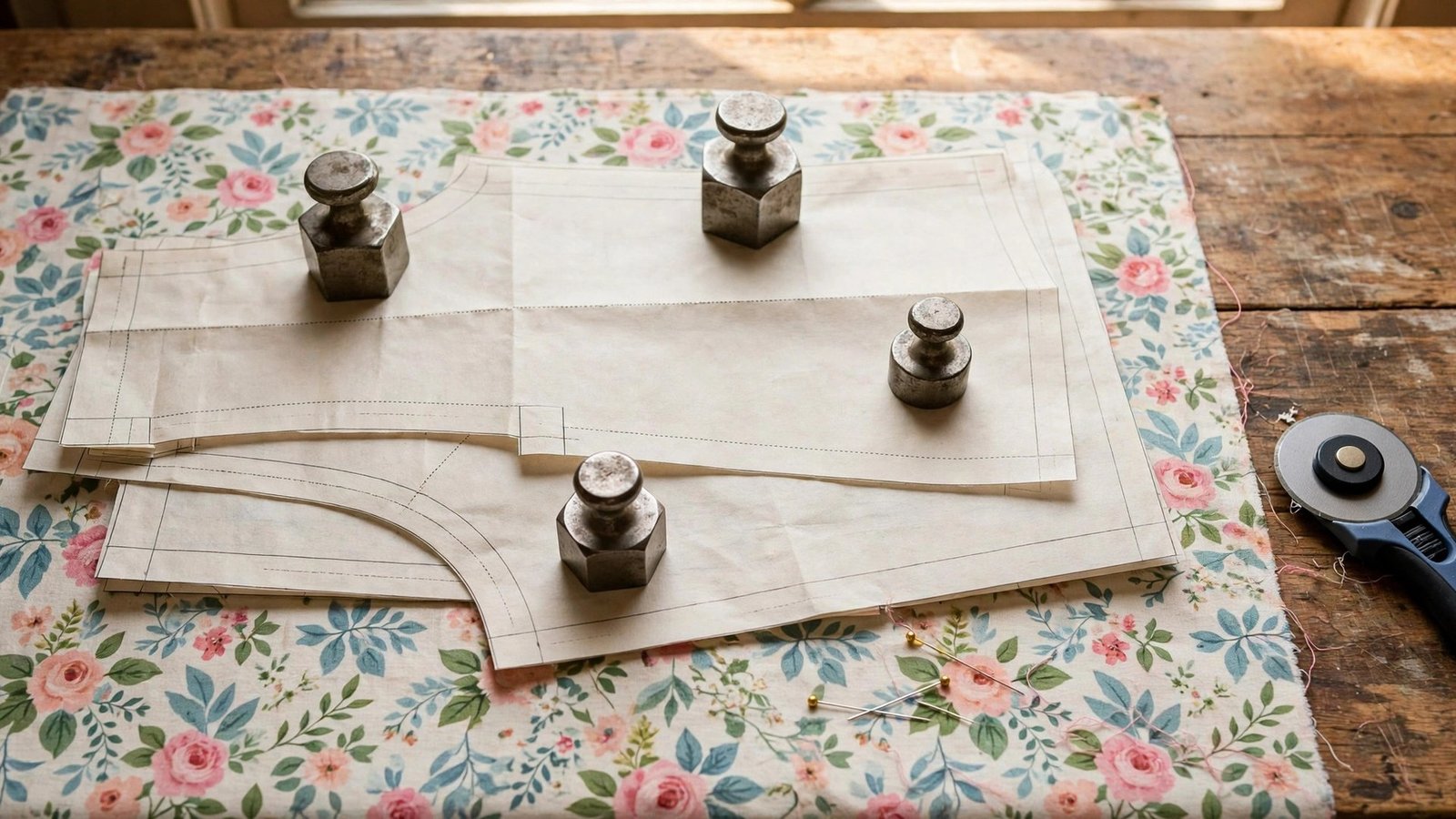
If you have ever wondered how to use pattern weights instead of pins, you are asking about one of the smallest changes that makes the biggest difference in cutting. Pattern weights are simply heavy objects that hold a paper pattern flat on the fabric while you cut, and they replace the pins that hold the pattern in place. No pins means no pin holes in delicate fabric, no shifting as you cut, and no stabbed fingertips. I switched to weights years ago, and I have never looked back.
Weights are especially good for slippery fabrics, like satin and rayon, and for fabrics that mark easily, like leather, vinyl, and silk. Pins leave holes in those fabrics that never close, and they can snag a fine weave. Weights just sit there, holding the pattern still while your rotary cutter glides around the edge. They are also faster than pinning, which matters when a pattern has many pieces. In this guide I will show you what to use as weights, how to place them, and how to cut accurately with them.
You do not need to buy anything special to start. A set of purpose made pattern weights is lovely, but a clean tin of beans, a smooth river stone, or a small bag of rice will do the same job. What matters is that the weight is heavy enough to hold the pattern flat, smooth enough not to snag the fabric, and clean enough not to mark it. Wash your hands, clear your table, and let us cut without a single pin.
What Pattern Weights Are and Why They Beat Pins
A pattern weight is any heavy, flat object that sits on top of a paper pattern and stops it moving while you cut. Purpose made weights are usually metal discs or squares with a handle on top, and they weigh enough to hold even a large pattern piece still. But the idea is older than any shop bought weight. Sewists have used smooth stones, metal washers, and even heavy mugs for generations, and they all work on the same principle: gravity holds the pattern, and your hands and cutter do the rest.
The main advantage over pins is that weights do not pierce the fabric. On leather, vinyl, oilcloth, and silk, a pin hole is permanent, and a row of pin holes along a seam line can ruin a garment before you sew a stitch. Weights also suit rotary cutting, because you can cut right up to the pattern edge without the blade hitting a pin. And they are kinder to your hands. Pinning a large pattern is slow and fiddly, while placing weights takes seconds. If you still use pins for other jobs, my guide to how to choose pins or clips will help you pick the right ones for those moments.
How to Use Pattern Weights Instead of Pins Step by Step
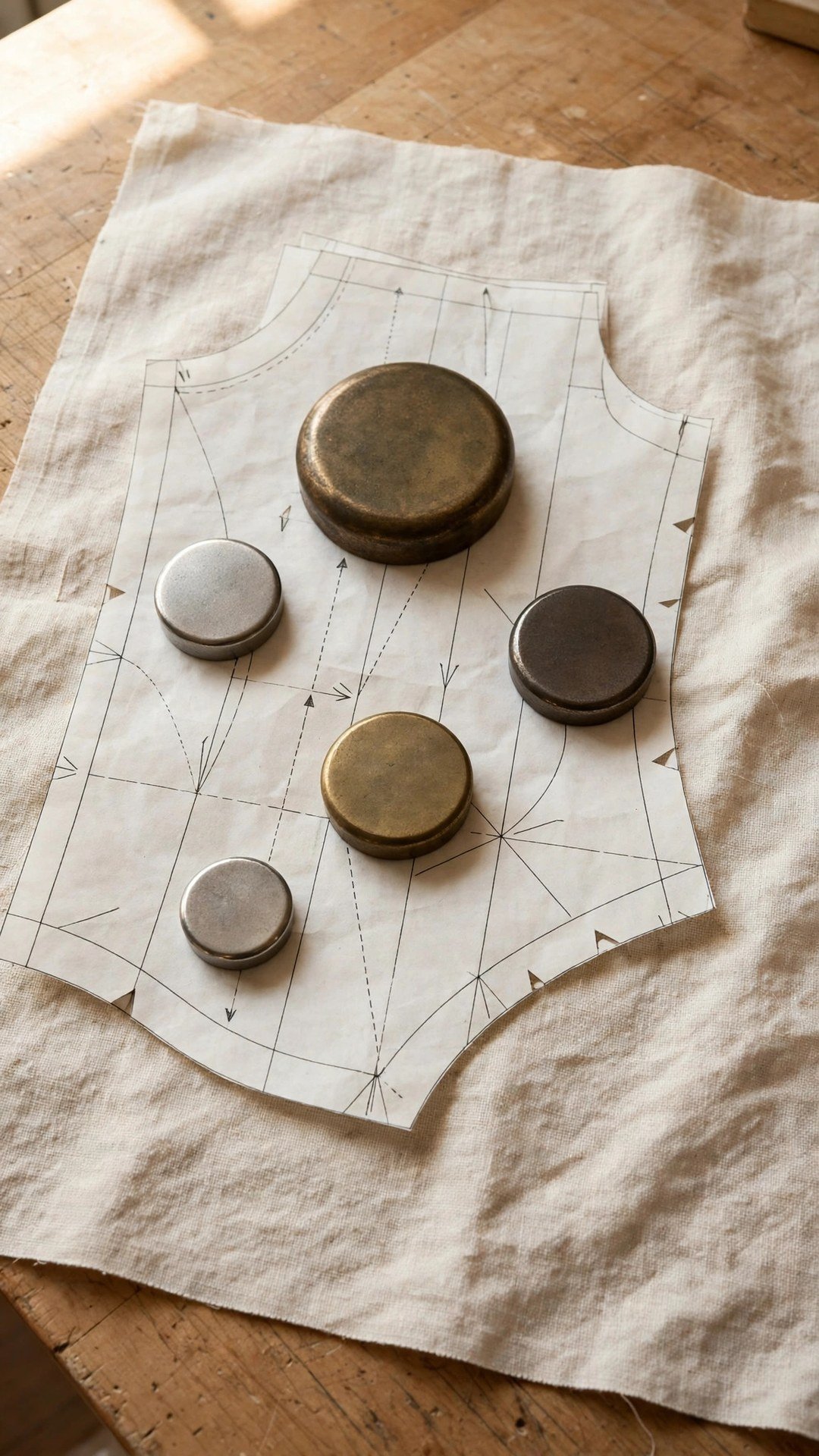
Start by laying your fabric out flat on the cutting table, smoothing it with your hands until there are no wrinkles or bubbles. Check the grainline first, because weights will not fix a pattern laid off grain, and a garment cut off grain will twist when worn. Lay the pattern piece on the fabric, line the grainline arrow up with the straight grain of the fabric, and smooth the paper flat with your palm. My guide to how to cut fabric on grain explains the grainline check in detail if you need a refresher.
Now place the weights. Put one weight near each corner of the pattern piece, and add more along long straight edges and around curves, spacing them about six inches apart. Place them on the paper, not on the bare fabric, and keep them a little back from the cutting edge so your rotary cutter or scissors can pass freely. Then cut with a rotary cutter and a ruler for straight edges, or with sharp scissors for curves, keeping the blade tight against the pattern edge. Work slowly around curves, lifting and repositioning the cutter rather than dragging it, and do not lift the pattern until every edge is cut.

Choosing Weights and Making Your Own
If you want to buy pattern weights, look for a set of four to six, each heavy enough to hold a large pattern piece still on a smooth table. Metal weights with a handle are the easiest to pick up and move, and flat discs stack neatly for storage. Avoid weights with rough edges or rust, because they can snag or stain fabric. A good set will last for years and will feel like a small luxury every time you use it.
Making your own weights is easy and fun, and it is a good first project in itself. Fill small fabric pouches with rice, dried beans, or clean aquarium gravel, stitch them closed, and you have soft weights that will not scratch a table or dent a pattern. Or wrap large metal washers in fabric and stitch a cover around them. Keep the weights clean and dry, and store them in a box or a jar so they do not roll off the table. I keep mine in a small basket beside the cutting mat, where I can reach them without thinking. For marking the pieces after cutting, how to trace pattern pieces shows how to transfer the markings once the weights come off.
When to Use Pins After All
Weights are wonderful, but they are not right for every job, and knowing when to reach for pins makes you a better sewist, not a less committed one. If your fabric is very lightweight and slides on the table, pins may hold it steadier than weights, especially if you are cutting with scissors and lifting the fabric as you go. If you are cutting a pattern on the fold and the fold itself needs holding, a pin at the fold line can help. And if you are cutting through many layers at once, pins through all the layers will stop them shifting in a way that weights on top cannot.
My rule is simple: weights for cutting flat pattern pieces on a table, pins for holding layers together while you sew. The two tools do different jobs, and a good sewing room has both. Use weights when the fabric would be damaged by pins, when you are rotary cutting, and when you want speed. Use pins when layers need to stay together through handling, when you are fitting on the body, and when you are holding a seam for sewing. And if you use clips, which are a third option, my notes on pin and clipping fabric compare all three so you can choose with confidence.

Frequently Asked Questions
What can I use as pattern weights at home?
Anything heavy, smooth, and clean will work: smooth stones, tins of food, metal washers, or small fabric pouches filled with rice or dried beans. Just make sure the object will not stain or snag your fabric.
Do pattern weights work on slippery fabric?
Yes, and slippery fabric is where they shine. Pins can slide and snag in satin and rayon, while weights hold the pattern flat without piercing the cloth. Add extra weights along the edges if the fabric still shifts.
Can I use pattern weights with scissors instead of a rotary cutter?
Yes, though it is a little slower. Keep the scissors flat against the table and cut close to the pattern edge, and do not lift the fabric while you cut. A rotary cutter is faster, but scissors work fine with care.
How many pattern weights do I need?
Four to six weights will cover most single pattern pieces. Large pieces like a coat back or a skirt panel may need six or eight. Start with four and add more as you learn how your fabric behaves.
Will weights damage delicate fabric?
Not if they are smooth and clean. Avoid rough stones or rusty metal, and place a scrap of fabric under a heavy weight if you are worried. Soft fabric pouches filled with rice are the gentlest option of all.
Cut Without Holes, Sew Without Worry
Pattern weights are a small, simple tool, and they change cutting from a fiddly chore into a calm, quick step. Lay the fabric flat, check the grain, place a weight at each corner, and cut with confidence. Your fabric will thank you for the lack of pin holes, and your fingers will thank you too.
Written by June Carter
I am June, a sewing enthusiast who loves turning simple fabric into things people actually use. I test every technique and product I write about at my own machine before it lands here.