If you have ever tried to sew jeans on a standard needle and ended up with skipped stitches, snapped thread, or a needle bent like a banana, you already know why learning how to choose denim needles matters. Denim is a dense, tightly woven twill, and it asks more of a needle than almost any other home-sewing fabric. The good news is that the fix is cheap and simple: put in the right needle, and most denim problems disappear instantly.
I am opinionated about this one. Nine times out of ten, when someone tells me their machine cannot sew denim, the machine is fine and the needle is wrong. A jeans needle costs very little and takes two minutes to install, yet it transforms how your machine handles everything from hemming jeans to sewing a denim tote. This guide covers what makes a denim needle different, which size to pick for your fabric weight, what to do about stretch denim, and when to change the needle.
Why Denim Destroys Ordinary Needles
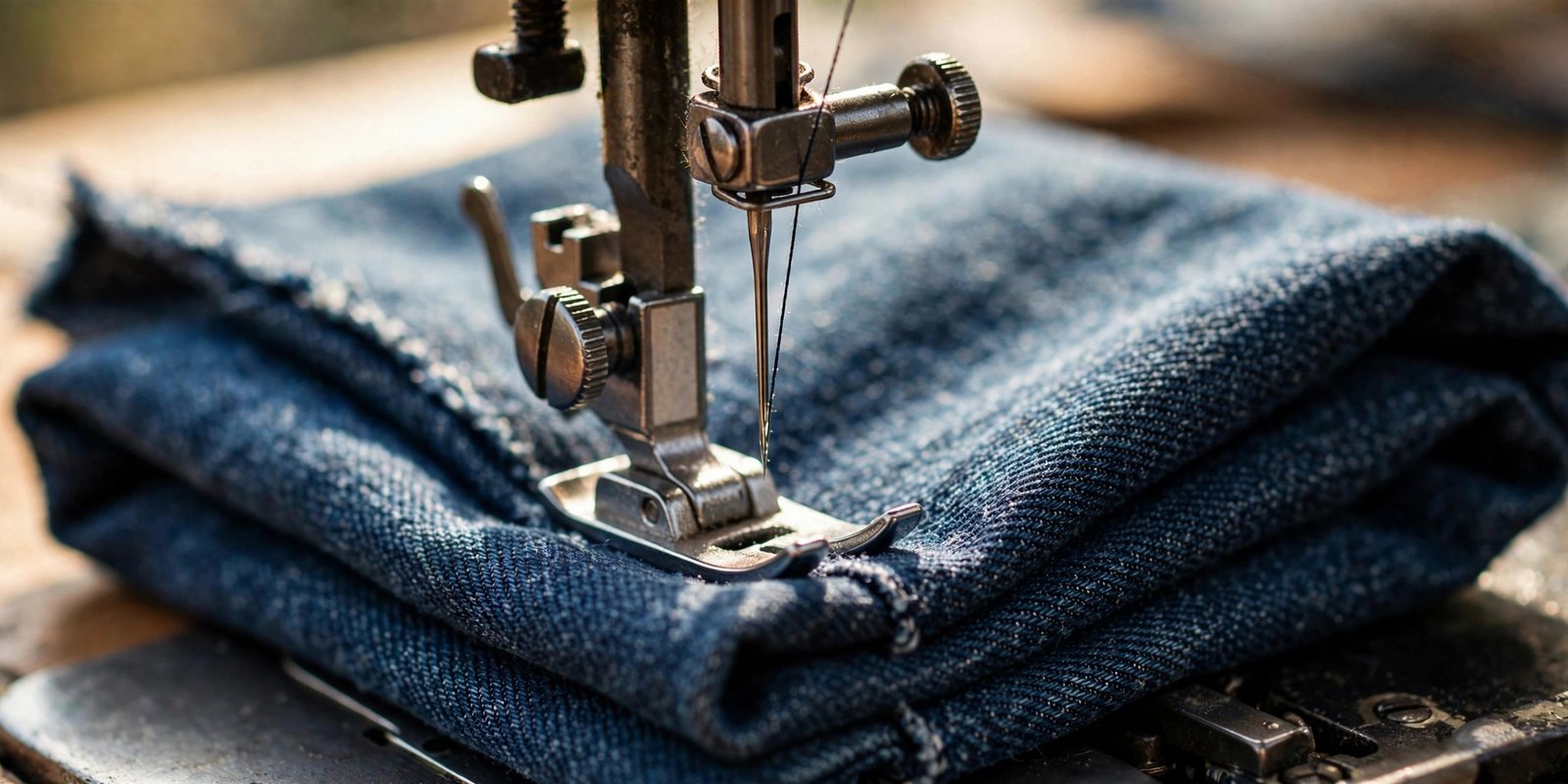
A universal needle is a compromise. It has a slightly rounded point designed to sew a bit of everything without damaging anything, which makes it perfect for average fabrics and wrong for denim. Denim’s tight twill weave resists penetration, so a universal point deflects slightly with every stitch instead of piercing cleanly. That deflection causes skipped stitches, where the hook misses the thread loop, and it flexes the needle until it snaps, usually at the worst possible moment.
Then there are the seams. A jeans hem can stack six or eight layers of denim at the flat-felled seams, and crossing one of those ridges with a lightweight needle is like driving over a speed bump at full speed. The needle bends, the timing shifts for a fraction of a second, and you get a nest of thread underneath or a broken needle tip embedded in your project. If you have ever had to fix skipped stitches on a denim project, the needle was very likely the culprit, not your machine.

What Makes a Jeans Needle Different
Jeans needles, sometimes labeled denim needles, are engineered specifically for dense woven fabrics. They have a reinforced, stronger shaft that resists deflection, a very sharp, slim acute point that pierces tight weaves instead of pushing them aside, and a larger eye with a deeper groove so heavier thread flows smoothly without shredding. Many brands also cut a deeper scarf, the indentation above the eye, which helps the hook catch the thread loop reliably and further reduces skipped stitches.
You can usually spot them by the blue color band on the shank, which most major brands use to mark the jeans needle type. They come in the standard home machine system, so they fit any regular domestic sewing machine. If you want the full background on needle anatomy and systems, my guide to choosing a sewing machine needle covers how the numbering and types work across all fabrics.
How to Choose Denim Needles by Fabric Weight
Needle sizes are written as two numbers, like 90/14. The first is the European metric size, the second the American size. They mean the same thing: bigger numbers mean thicker needles for heavier fabrics. Match the needle to your denim weight and you will rarely go wrong.
For lightweight denim and chambray, around 8 to 10 ounces, a 90/14 jeans needle is ideal. It pierces cleanly without leaving visible holes. For medium-weight denim, the classic 10 to 12 ounce jeans fabric most jeans are made from, 90/14 remains the workhorse size for general sewing, hemming, and standard seams. Step up to 100/16 for heavyweight denim over 12 ounces, for hemming jeans across those thick flat-felled seams, and for any project with many layers. Reserve 110/18 for extra-heavy denim, workwear, and upholstery-weight fabrics.

My rule of thumb: when in doubt, size up. A needle slightly too large makes a marginally bigger hole that closes up in the wash, while a needle slightly too small skips stitches and breaks. And always test on a layered scrap of your actual project fabric before you sew. Sew across a doubled seam exactly like the ones in your project. If the stitches are even and the machine sounds happy, you have the right needle.
Stretch Denim Breaks the Rules
Here is the exception that trips people up. Stretch denim contains elastane, and a sharp jeans point can cut those elastic fibers, leaving tiny runs and weakening the stretch. For stretch denim, switch to a stretch needle, usually in 90/14. It has a rounded point that slides between fibers instead of cutting them and a specially shaped scarf that virtually eliminates skipped stitches on elastic fabrics.
This is one case where matching the needle to the fiber matters more than matching it to the weight. A medium-weight stretch jean sews better with a 90/14 stretch needle than with a 90/14 jeans needle, even though the fabric is the same weight. If your stretch denim project is skipping stitches and you are already using a jeans needle, this is almost certainly why. Change to the stretch needle and watch the problem vanish.
When to Change Your Needle and How to Test
Needles are consumables, not lifetime tools. As a habit, install a fresh needle at the start of every denim project, and replace it after about eight hours of sewing or at the first sign of trouble. The signs are unmistakable once you know them: skipped stitches, a popping or thudding sound as the needle hits the fabric, thread that shreds or breaks, puckered seams, or visible damage to the fabric around the stitch line.

Changing a needle takes two minutes. Turn the machine off, loosen the needle clamp screw, slide the old needle out, and insert the new one with the flat side of the shank facing the back, pushing it up as far as it will go before tightening. Then test on a scrap sandwich that mimics your project, including a crossed seam. Also pair your needle with suitable thread: a good all-purpose polyester handles most denim sewing beautifully. For heavier decorative topstitching thread, step up to a topstitch needle with its extra-large eye. My notes on the best thread for sewing machines will help you match thread weight to needle size. And since denim sheds a shocking amount of lint, give your machine a lint clean-out after heavy denim sessions to keep everything running smoothly.
FAQ
Can I use a universal needle to sew denim?
For very lightweight denim or chambray, a fresh universal 90/14 can manage, but a jeans needle will still sew it better. For medium denim and anything heavier, switch to a proper jeans needle. The reinforced shaft and sharp point are not marketing, they solve real deflection and skipped-stitch problems.
What size needle do I need to hem jeans?
A 90/14 jeans needle handles most jeans hemming. If you are crossing the thick flat-felled outseam and the machine struggles or skips, move up to a 100/16 for that section. Sew slowly over the bulky ridge, and consider using a hump jumper or folded cardboard behind the foot to keep it level.
Why is my machine skipping stitches on thick denim seams?
The most common causes are a needle that is too small or too dull for the layers, in that order. Size up to 100/16, install a fresh needle, and slow down over the thick spots. If it still skips on stretch denim specifically, switch to a stretch needle instead.
Do I need a special sewing machine to sew denim?
No. Most modern home machines sew denim happily with the right needle, good thread, and sensible technique. Go slowly over thick seams, lengthen your stitch slightly, and let the feed dogs move the fabric rather than pushing it. The needle does the heavy lifting, not the machine.
Written by June Carter
I am June, a sewing enthusiast who loves turning simple fabric into things people actually use. I test every technique and product I write about at my own machine before it lands here.