
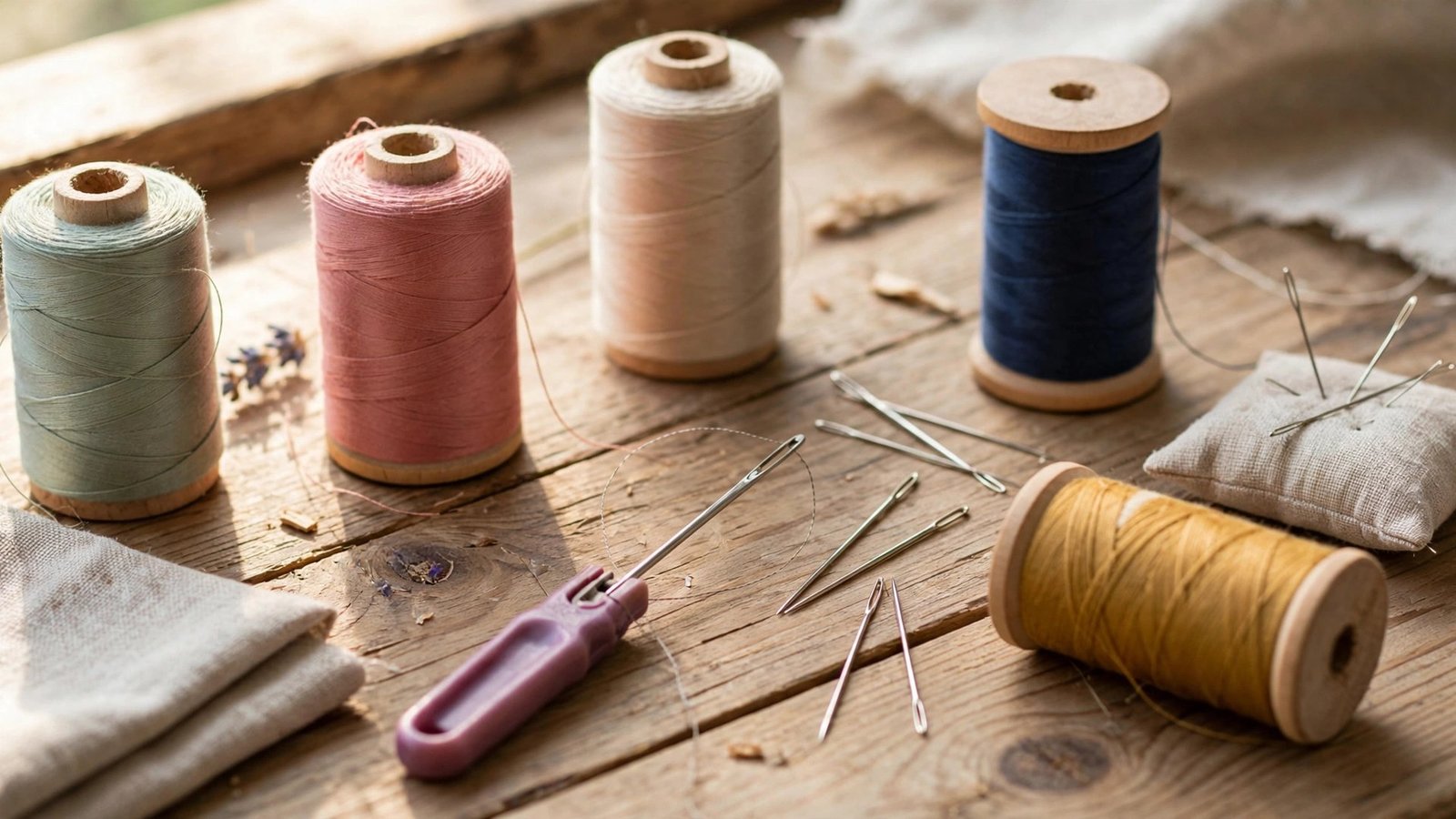
Learning how to use a needle threader is a small skill with an outsized payoff, especially if your eyesight is tired, the light is poor, or the needle eye is tiny. A threader does in seconds what fumbling with a thread end can take minutes to do, and it saves the frustration that makes many sewists give up on hand sewing altogether.
There are two main kinds of threader: the small handheld wire threader you use with hand needles, and the built-in threader on many sewing machines. Both work on the same idea, which is to push a thin loop through the needle eye, pass the thread through the loop, and pull the loop back out with the thread in tow. Once you understand that idea, both kinds make sense.
In this guide I will show you how to use each kind, step by step, and how to fix the problems that make threaders feel fiddly. My guide to how to thread a sewing machine covers the full threading path, and this one focuses on the threader itself.
How a Needle Threader Works
A handheld needle threader is a flat piece of metal with a fine wire loop at one end. The wire loop is thin enough to pass through the eye of a needle, and it springs back to shape after you pull it through. That loop is the whole trick: it carries the thread through an eye that is too small or too awkward to thread by hand.
A built-in machine threader works the same way, with a small hook that swings through the needle eye, catches the thread, and pulls a loop back through. The machine does the pushing for you, and you guide the thread into place. Different machines have slightly different levers, but the idea is the same on all of them.
Threaders are cheap, light, and easy to lose, so keep one in your needle case and one by your machine. A threader that is always within reach gets used. One buried in a drawer does not, and then you are back to squinting at the needle eye.

How to Use a Handheld Wire Threader
Hold the needle in one hand, with the eye facing you and the point held safely away from your fingers. Hold the threader in your other hand by its flat handle. Push the wire loop through the eye of the needle from the front, until the loop sticks out on the other side. The loop should pass through easily; if it does not, the loop may be bent, or the needle eye may be too small for that threader.
Pass the end of your thread through the wire loop, leaving a short tail of a few inches. Then pull the threader back out through the eye, slowly and steadily. The loop carries the thread through the eye with it. Once the thread is through, slip it out of the loop and pull it to the length you need.
If the thread slips out of the loop, try a slightly longer tail through the loop, and pull more slowly. If the wire loop is bent, straighten it gently or replace the threader, because a bent loop snags in the eye. Wire threaders are inexpensive, so I keep spares, and I replace one as soon as it starts to catch.
How to Use a Built-in Machine Threader
Start with the needle at its highest point. Turn the handwheel towards you until the needle is fully up, and check that you are using the correct needle size for the threader: very fine needles and very thick needles can both confuse a built-in threader, so check your manual for the sizes it supports.
Lower the threader lever slowly, following your manual, until the small hook passes through the needle eye. Lay the thread across the hook or in the guide, exactly as the manual shows, and hold the thread end gently. Then release the lever slowly. The hook pulls a loop of thread back through the eye, and you can pull that loop through to the back of the needle.
If the threader misses, raise the needle a fraction higher, or lower it a fraction, and try again. A needle that is slightly too high or too low is the most common reason a built-in threader fails. Do not force the lever. A gentle, slow movement works better than a quick flick, and forcing it can bend the hook.

Common Threader Problems and Fixes
If the wire loop will not go through the eye, check that the loop is straight and that the needle eye is large enough for the threader. Some very fine needles need a finer threader, and some threaders are made for larger eyes. Match the threader to the needle, not the other way round.
If the thread keeps slipping out of the loop, use a longer tail through the loop, keep the thread end flat rather than frayed, and pull slowly. A frayed thread end catches and slips, so trim the end cleanly with sharp scissors before you thread. A clean cut makes a real difference.
If the built-in threader keeps missing the eye, check the needle position, check that the needle is fully seated in its clamp, and check that the needle is not bent. A bent needle changes the position of the eye by a fraction, and that fraction is enough to miss. Replace a bent needle, then try the threader again. My notes on how to choose a sewing machine needle help you pick the right needle for the job.
Choosing the Right Threader for You
For hand sewing, a simple wire threader is enough for most needles, and a pack of several costs very little. For fine embroidery needles, look for a threader with a finer wire. For machine sewing, the built-in threader is convenient, but a handheld threader works as a backup when the built-in one is fussy.
There are also threaders with a small magnifier, a light, or a larger handle, which help if your hands are stiff or your eyes tire easily. These are worth trying if a standard threader feels awkward. The best threader is the one you can use comfortably, every time, without thinking about it.
Keep your threaders clean and dry, and store them flat so the wire loop does not bend. A bent loop is the most common reason a threader stops working, and it is also the easiest problem to prevent. Treat the threader kindly, and it will thread needles for you for a long time.

Frequently Asked Questions
How does a needle threader work?
A thin wire loop or hook passes through the needle eye, you pass the thread through the loop, and you pull the loop back out. The loop carries the thread through the eye with it.
Why will my wire threader not go through the needle eye?
The loop may be bent, or the needle eye may be too small for that threader. Straighten the loop gently or use a finer threader, and match the threader to the needle size.
Why does my machine threader keep missing?
The needle is often slightly too high, too low, or not fully seated, or it is bent. Raise the needle to its highest point, check it is fully seated, replace a bent needle, and move the lever slowly.
Can I use a needle threader with any needle?
Most hand needles work with a wire threader, but very fine needles need a finer threader. Built-in machine threaders support a range of needle sizes listed in your manual, so check before you use one with a very fine or very thick needle.
What if the thread keeps slipping out of the loop?
Use a longer tail through the loop, trim the thread end cleanly so it does not fray, and pull the threader back slowly and steadily.
Thread It Once, Sew Without the Squint
A needle threader is a tiny tool that removes a daily frustration. Learn the loop, keep the wire straight, position the machine needle correctly, and move slowly. Once the habit is in your hands, threading a needle becomes the easiest part of sewing, not the part you put off.

Written by June Carter
I am June, a sewing enthusiast who loves turning simple fabric into things people actually use. I test every technique and product I write about at my own machine before it lands here.