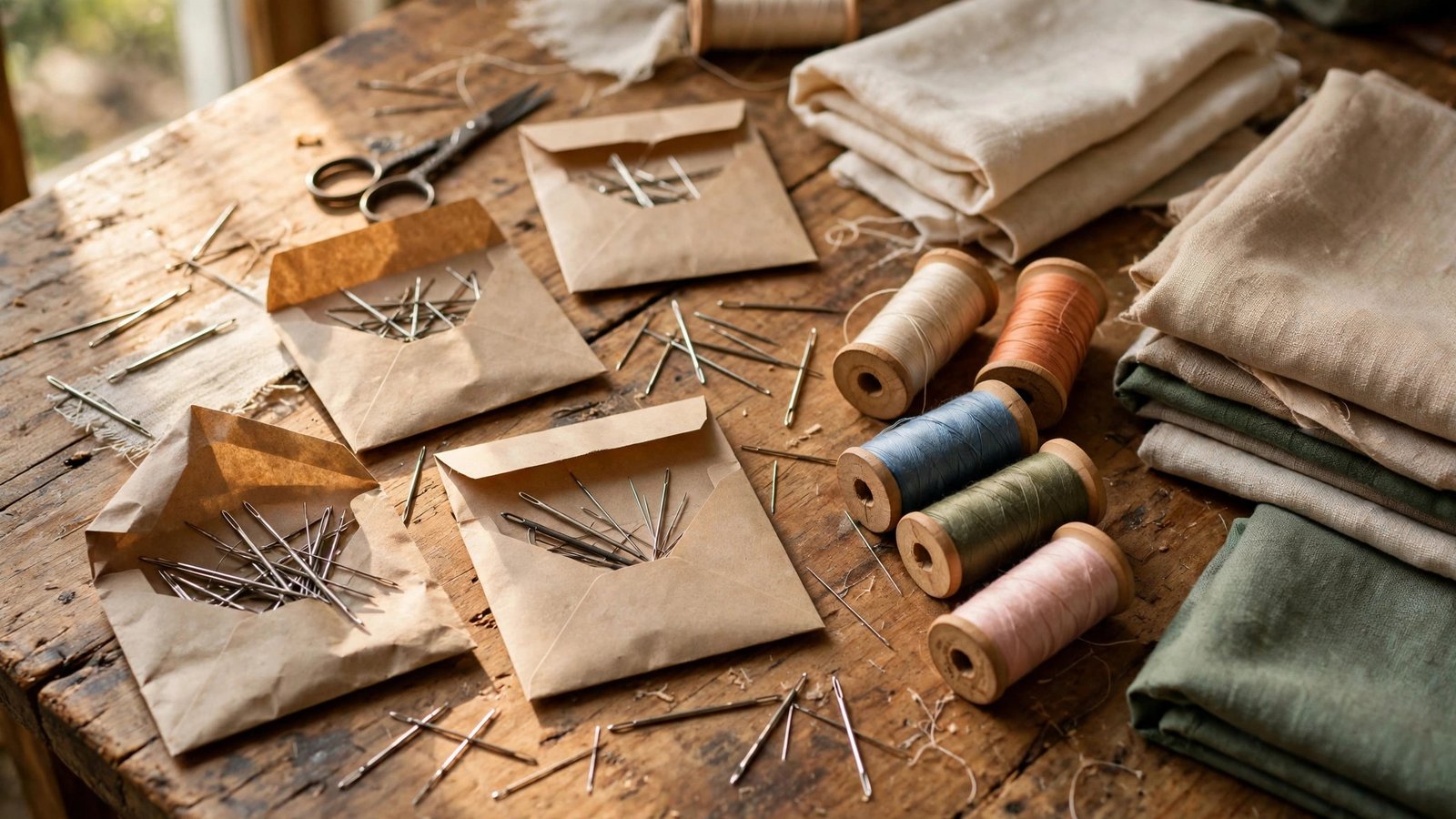
Let me tell you about the most underrated upgrade in all of sewing. It costs almost nothing, takes thirty seconds, and can fix skipped stitches, puckering, and broken thread in one move. It is changing your needle. Most of us sew everything with whatever needle came in the machine, and then wonder why our knit top looks like it was attacked. Learning how to choose universal and stretch needles properly will improve your sewing more than almost any other single habit, and I am slightly embarrassed by how long it took me to learn this.
The needle is the only part of the machine that touches both the thread and the fabric on every single stitch. Its point shape, its eye size, and its thickness all change how the stitch forms. Universal needles and stretch needles are the two types you will reach for most often, but they are designed for completely different jobs. Use the wrong one and the machine will tell you, loudly, in the language of skipped stitches and snapped thread.
What a Universal Needle Is Good For
A universal needle is the everyday workhorse of the sewing world. It has a slightly rounded point that is sharp enough to pierce woven fabrics cleanly but gentle enough not to destroy everything it touches. For quilting cotton, linen, poplin, broadcloth, and most medium-weight wovens, a universal needle in size 80/12 or 90/14 is exactly right, and it will serve you beautifully.
The word universal is doing some heavy lifting in that name, though. It is a compromise design, which means it is good at many things and the best at none. It handles everyday wovens and even some stable knits in a pinch, but the moment you move to truly stretchy fabrics, its limitations show. Think of it as your default needle: start here for wovens, and switch away the moment the fabric has real stretch.
What Makes a Stretch Needle Different
A stretch needle looks similar at a glance, but its engineering is specialized for elastic fabrics. It has a medium ballpoint tip that slides between the loops of knit fabric instead of piercing them, which prevents runs, holes, and laddering. More importantly, it has a specially designed eye and scarf, the groove above the eye, that helps the machine’s hook catch the thread reliably on every stitch.
That scarf design is the whole reason stretch needles cure skipped stitches on knits. When a knit fabric flexes under the needle, a standard needle lets the thread loop slip away from the hook, and you get those maddening gaps in your seam. The stretch needle’s geometry keeps the loop where the hook can grab it. If you sew swimwear, activewear, or any knit with spandex content, a stretch needle in 75/11 or 90/14 is not optional. It is the correct tool.

How to Choose Universal and Stretch Needles for Your Fabric
Here is the decision framework I use. First, ask whether the fabric stretches. If it is a woven with no stretch, meaning cotton, linen, denim-weight wovens, or canvas, reach for the universal needle and match the size to the weight: 70/10 or 80/12 for light fabrics, 80/12 or 90/14 for medium weights. The rule is to use the smallest needle that still penetrates cleanly, because oversized needles leave visible holes in fine fabrics.
If the fabric is a knit, ask how much stretch it has. For a stable jersey or interlock with moderate stretch, a ballpoint or jersey needle in 80/12 usually does the job, and this is where many sewists stop. But for highly elastic fabrics, anything with lycra or spandex, swimwear, or activewear, step up to a true stretch needle. The ballpoint will be better than a universal, but the stretch needle’s special scarf is what guarantees reliable stitch formation on the stretchiest fabrics.
For heavy or tricky fabrics outside this pair, know when to switch lanes entirely: denim and canvas want a jeans needle with a reinforced blade, and leather wants a leather needle with a cutting point. But for the everyday choice between universal and stretch, the fabric’s stretch is the whole decision. Wovens get universal, stretchy knits get stretch, and when in doubt on a knit, the stretch needle is the safer bet.
Needle Sizes Demystified
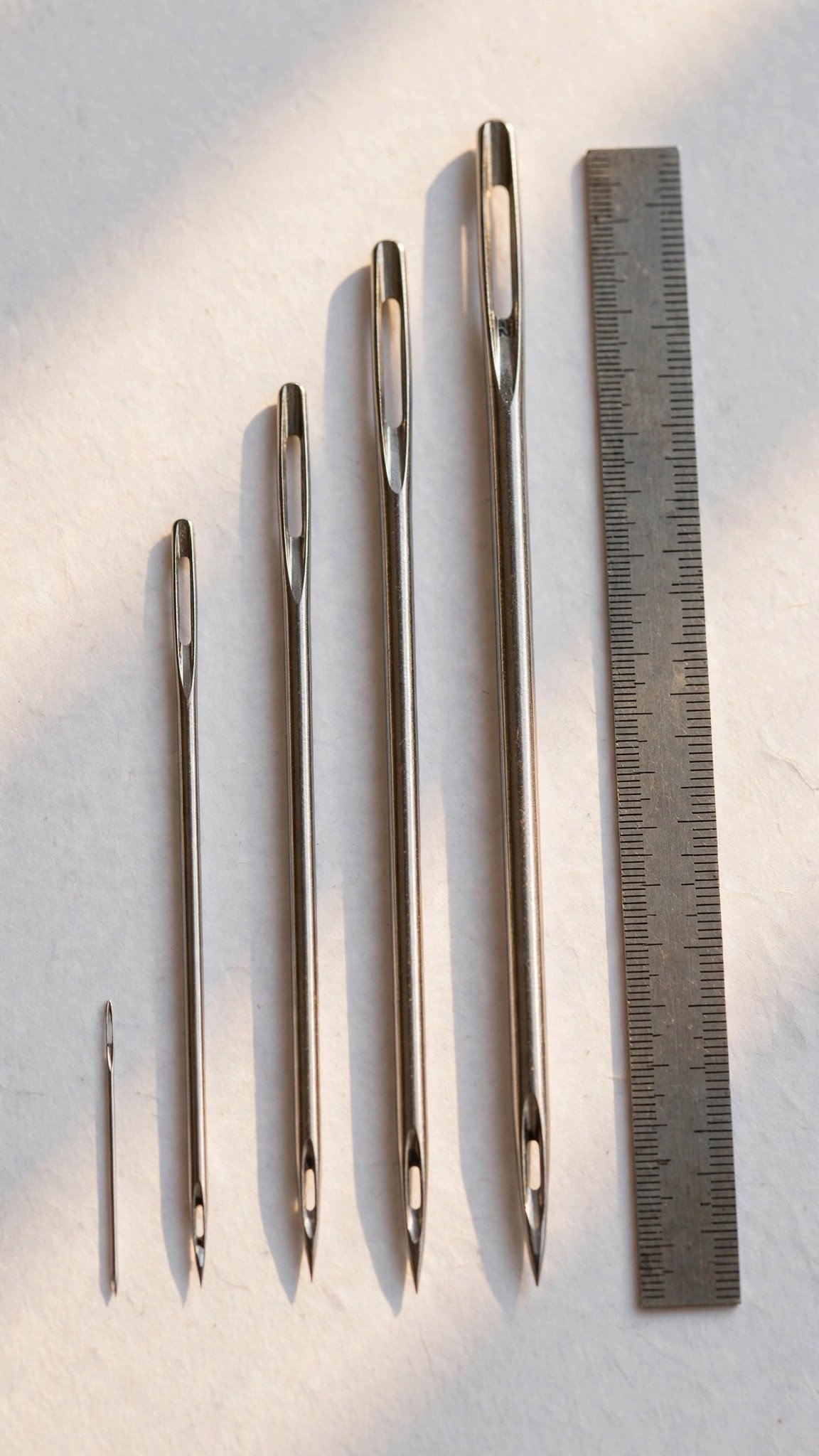
Needle sizes look cryptic until someone explains them, and then they are simple. The two numbers, like 80/12, are the same measurement in two systems: the first is the European metric size, the diameter of the blade in hundredths of a millimeter, and the second is the American size. Bigger numbers mean thicker needles. That is the entire system.
Match the size to your fabric and thread weight. Fine fabrics like voile and silk want 60/8 or 70/10. Everyday quilting cotton and linen are happiest with 80/12. Medium to heavy fabrics like denim-weight wovens want 90/14. And pair your thread sensibly: fine threads with small needles, heavier topstitching threads with larger needles that have bigger eyes. A heavy thread dragged through a tiny needle eye will shred, and no amount of tension adjustment fixes that.
One more detail worth knowing: most home machines use the 130/705 H system, which is the standard flat-shank needle you find everywhere. Check your manual if you are unsure, but for nearly every modern home machine, that is the system you are buying.
Signs You Are Using the Wrong Needle
Your machine gives you clear feedback if you listen. Skipped stitches on knit fabric are the classic cry for a stretch needle, and switching usually fixes it instantly. If you are getting puckered seams on a knit, or the fabric is laddering with little runs along the stitch line, your needle point is cutting fibers instead of slipping between them, and a ballpoint or stretch needle will stop it.
Shredded or broken thread often means the needle eye is too small for the thread, so size up. Visible holes left in the fabric mean the needle is too large, so size down. And a machine that suddenly starts misbehaving after weeks of good sewing often just needs a fresh needle. Needles dull with use, and a dull needle pushes fabric instead of piercing it. I change mine at the start of every project, and for big projects, I change it in the middle too. It is the cheapest maintenance in sewing.
If you have ruled out the needle and still have trouble, troubleshoot skipped stitches systematically, and make sure your machine is threaded correctly by following a proper threading guide. But check the needle first. It is the culprit more often than anyone admits.
Changing Your Needle the Right Way
Changing a needle takes less than a minute once you know the drill. Turn the handwheel to raise the needle to its highest position and turn the machine off. Loosen the needle clamp screw, slide the old needle down and out, and note which way the flat side of the shank faced. Insert the new needle with the flat side facing the same direction, usually toward the back, and push it up as far as it will go. Tighten the screw firmly, but do not force it.
Then test on a scrap of your actual project fabric before you sew the real thing. Sew a few inches, check both sides of the seam, and look for even stitches with no skipping, no puckering, and no holes. This thirty-second test has saved me from sewing entire garments with the wrong needle more times than I care to admit. Keep a small labeled box of needles by your machine with universal, ballpoint, stretch, and jeans needles in the common sizes, and choosing correctly becomes effortless.

FAQ
Can I use a universal needle on knit fabric?
For a very stable knit you might get away with it, but I do not recommend it. A ballpoint needle is better for ordinary knits, and a true stretch needle is the right choice for anything with real elasticity. The wrong point shape causes skipped stitches and damaged fibers.
What is the difference between a ballpoint and a stretch needle?
Both have rounded tips for knits, but the stretch needle adds a specially designed eye and scarf that helps the hook catch the thread on highly elastic fabrics. For jersey, a ballpoint is fine. For lycra, spandex, and swimwear, choose the stretch needle.
How often should I change my sewing machine needle?
At the start of every project is my rule, and halfway through large ones. A needle also needs replacing at the first sign of trouble: skipped stitches, frayed thread, or a popping sound as it pierces the fabric all mean the needle is dull or damaged.
What size needle should a beginner buy first?
Start with universal 80/12, which handles most beginner cottons beautifully, and add a pack of stretch 75/11 or 90/14 for knit projects. With those two packs and a good all-purpose thread, you can sew nearly every beginner project with confidence.
Written by June Carter
I am June, a sewing enthusiast who loves turning simple fabric into things people actually use. I test every technique and product I write about at my own machine before it lands here.