
I once interfaced the collar of a voile blouse with heavyweight fusible interfacing, because it was the interfacing I had and the collar was the collar I wanted. The result stood up around my neck like a dog’s ear and refused to lie flat through three pressings, two washings, and one long disappointed stare. Interfacing is the ingredient nobody sees and everybody feels, and choosing it by fabric weight instead of by whatever is in the drawer is the difference between a collar that behaves and a collar with ambitions.
Here is how to choose interfacing by fabric weight: what interfacing actually does, the fusible versus sew-in decision, the three families you will meet at the store, a weight-matching chart I wish someone had taped to my first sewing table, and how to fuse it without bubbles.

What interfacing actually does
Interfacing is a hidden layer of structure sewn or fused inside your garment. It gives collars their crispness, cuffs their snap, facings the body to lie flat, waistbands the firmness to hold their shape, and button bands the stability to survive buttonholes. Without it, a collar flops, a facing rolls to the outside, and a waistband stretches into a sad ribbon by noon.
You will find interfacing doing quiet work in shirt collars and cuffs, jacket fronts, neckline and armhole facings, waistbands, pocket flaps, and anywhere a pattern says the words crisp, stable, or structured. It is never the star of the garment. It is the stage crew, and the show falls apart without it.
Fusible vs sew-in: your first decision
Fusible interfacing has heat-activated glue on one side. You lay it glue-side down on the wrong side of your fabric, press with an iron, and it bonds. It is fast, it is tidy, and it is what most home sewists reach for most of the time. The bond also stabilizes the fabric against stretching while you sew, which is a genuine bonus on bias-cut or loosely woven pieces.
Sew-in interfacing has no glue. You cut it like a pattern piece and baste or stitch it to the fabric. Choose sew-in when the fabric cannot take heat, like some synthetics and heavily textured weaves, when you want zero risk of glue showing through on very sheer fabric, or when you are after a softer, more traditional tailored feel. The fusible versus sew-in question is really a question about your fabric: can it be ironed firmly without damage, and do you want speed or softness? When in doubt, fusible wins for everyday sewing, and sew-in wins for fussy fabrics.
Woven, nonwoven, and knit: the three families
Walk into the interfacing aisle and you will meet three families. Woven interfacing is actual woven fabric, with a grainline like any other woven. It drapes like fabric because it is fabric, and it is my default for collars, cuffs, and anything on a woven garment where you want the interfacing to move the way the garment moves. Nonwoven interfacing is pressed fibers, more like paper than cloth. It has no grain, it is inexpensive, and it works fine for facings and crafts, but it can feel papery and it does not drape. Knit interfacing, often called tricot, has stretch. It is the right call for knit garments and for any fabric where you want stability without stiffness, like a softly structured jacket front.
Quick rule of thumb: match the family to the fabric. Woven interfacing for woven garments, knit interfacing for knits, nonwoven for facings and utility work where drape does not matter. Getting the family right matters as much as getting the weight right.
Match the weight, not the name
Here is the chart I wish someone had given me before the dog-ear collar incident. Interfacing weight should be equal to or slightly lighter than your fabric weight, never heavier. A crisp collar comes from the right weight fused properly, not from the heaviest interfacing in the drawer.
Sheer fabrics like voile, chiffon, and organza want featherweight or sheer fusible interfacing. Anything heavier will show through or overwhelm the fabric. Lightweight fabrics like quilting cotton, lawn, and linen shirting pair with lightweight fusible interfacing. Medium-weight fabrics like linen suiting, twill, denim shirting, and poplin want medium-weight interfacing, and this is the workhorse pairing for most shirt collars and cuffs. Heavy fabrics like denim, canvas, and wool coating need heavyweight or craft-weight interfacing to make any impression at all.
The names vary by brand, which is why you match by feel, not by label. Hold the interfacing against your fabric and ask: does this feel like a slightly firmer version of my fabric, or does it feel like armor? You want the former. And always cut a test swatch and fuse it to a scrap first. Ten minutes of testing beats unpicking a fused collar, which ranks somewhere between unpleasant and impossible.

Which interfacing goes where
Collars and cuffs on a shirt want medium-weight woven fusible interfacing, the classic pairing that gives a collar its roll and a cuff its snap. Facings, the pieces that turn necklines and armholes to the inside, want lightweight fusible, enough to stop stretching and rolling but not enough to feel stiff against the skin. Waistbands want medium to heavyweight depending on the trouser fabric, because a waistband does structural work all day. Button bands want lightweight to medium so the buttonholes have something to bite into. For knit garments, use knit fusible interfacing everywhere you would interface a woven, so the stretch survives. When a pattern just says interfacing with no further detail, lightweight woven fusible is the safest default for most apparel sewing.
How to fuse it without bubbles
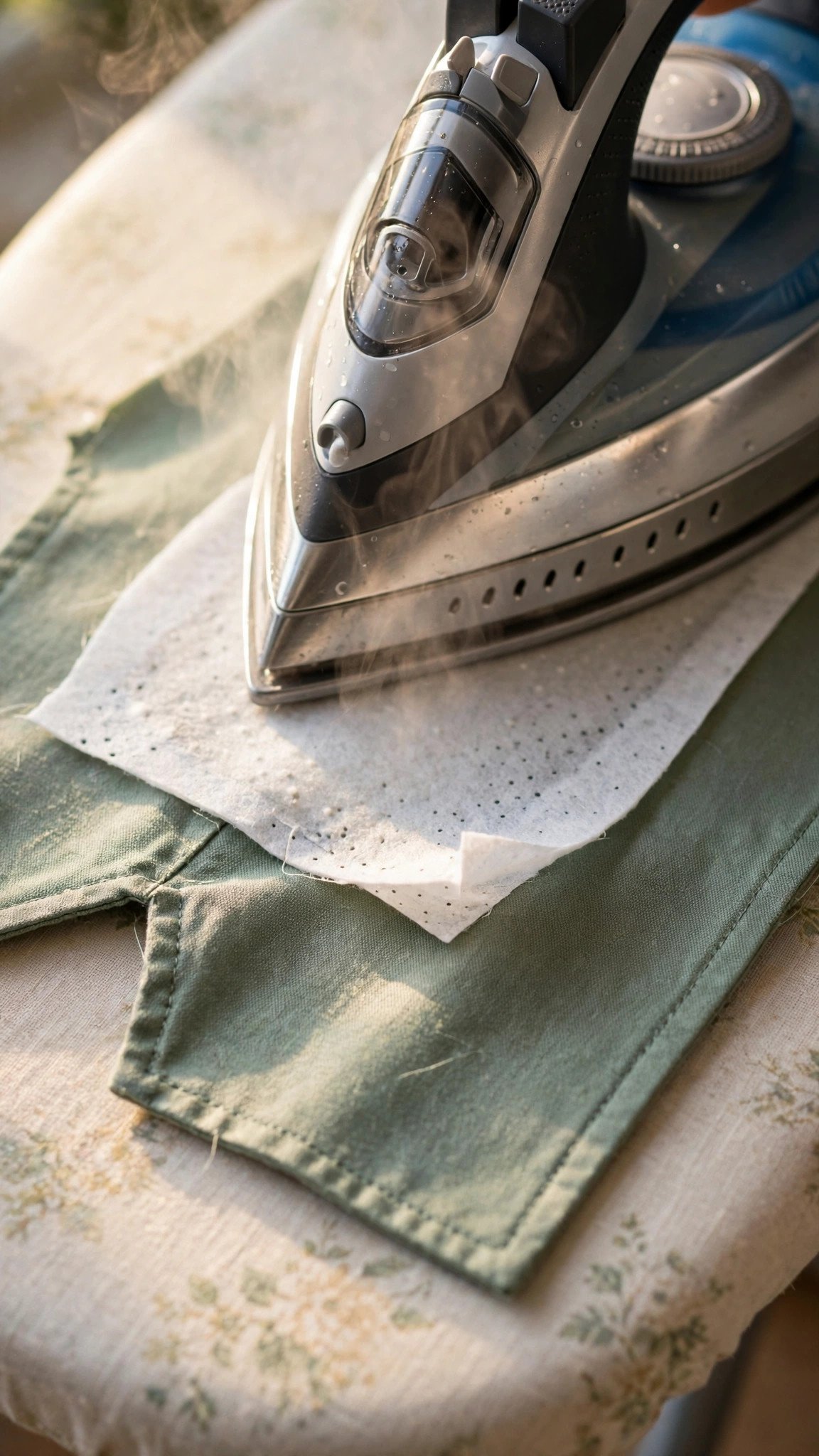
Bubbling, those little air pockets between interfacing and fabric, comes from rushing. Here is the method that works: cut the interfacing slightly smaller than the fabric piece so no glue extends past the edge, lay it glue-side down on the wrong side of the fabric, and cover it with a press cloth. Press straight down with a hot, dry iron and hold for ten to fifteen seconds per section. Lift and place the iron, do not slide it, because sliding shifts the layers and traps air. Overlap your press placements slightly so no section is missed, then let the whole thing cool completely before you move it. The bond sets as it cools, and handling it hot is how you get peeling edges a week later.
Check your test swatch first for the right heat and time, because every interfacing has its own temperament. Too cool and it peels. Too hot and it can bubble or, on synthetics, melt something you will regret. Steam helps some interfacings and hurts others, so read the bolt end or the package. I know reading the package is boring. Bubbles are more boring.
Frequently asked questions
Can I skip interfacing if the pattern calls for it? You can, in the same way you can skip the foundation of a house. The garment will look fine for about a day, then the collar will wilt, the facing will roll out, and the waistband will stretch. Interface what the pattern tells you to interface.
What if my fusible interfacing will not stick? Three usual suspects: the iron is not hot enough, you did not press long enough, or you pressed with steam on an interfacing that wants dry heat. Re-press hotter and longer on a test scrap. If it still will not bond, the interfacing may be old, because the glue does lose potency over the years.
Should I prewash interfacing? Fusible interfacing can shrink slightly when first heated, which is one more reason for the test swatch. I do not prewash fusible, but I do preshrink the fabric it is going onto, since a shrinking fabric under a non-shrinking interfacing is how you get puckering. My guide to how to prewash cotton and linen covers the fabric side of that equation.
Woven or nonwoven for a shirt collar? Woven, every time. A collar moves, folds, and rolls, and woven interfacing moves with it because it has a grainline. Nonwoven works for a facing that just needs to lie flat, but on a collar it feels like cardboard had a baby with paper.
Can I use interfacing on knit fabric? Yes, but use knit fusible interfacing, the tricot kind. Woven interfacing on a knit kills the stretch you bought the knit for, and the garment will fight you at every seam. Match the family to the fabric, like I said.
The collar test
Here is my whole philosophy in one sentence: fuse a test swatch, hold it up, and ask whether it feels like a slightly firmer version of your fabric. If yes, you chose right. If it feels like armor or like nothing at all, go one weight lighter or heavier and test again. Interfacing is invisible when it is right and unforgettable when it is wrong, and now you know how to get it right before the iron ever touches the real collar.

Written by June Carter
I am June, a sewing enthusiast who loves turning simple fabric into things people actually use. I test every technique and product I write about at my own machine before it lands here.